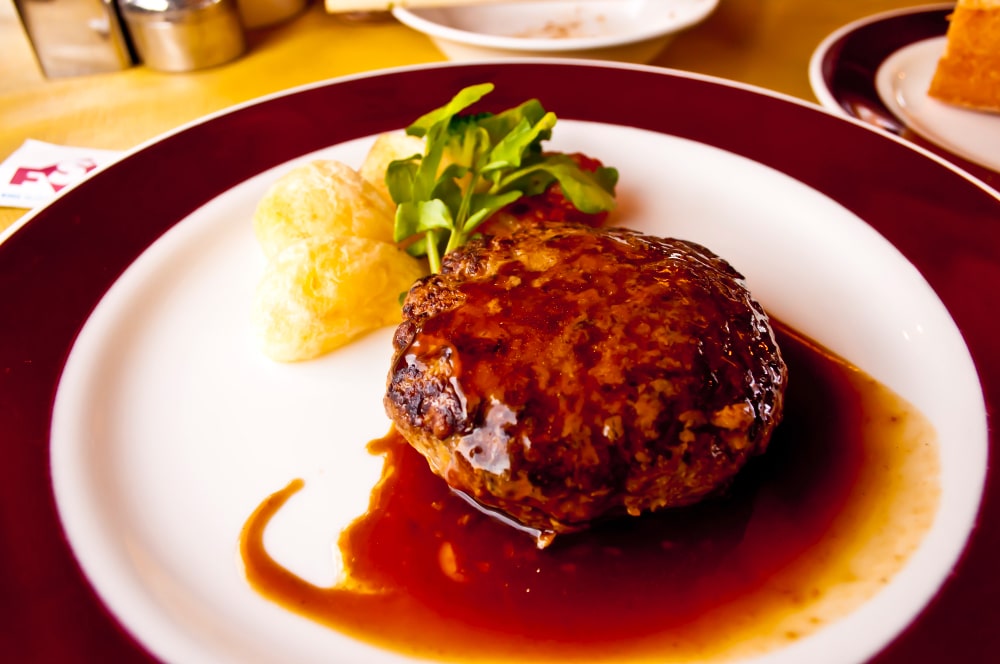
As you lie in bed, dozing away after a long day at school, a lovely aroma wafts into your bedroom from the kitchen downstairs, shaking you from your sleep. It seems Mom has cooked up your favorite. You let the savory scent fill your lungs, and your mouth begins to water in anticipation of the sensational delight that awaits you tonight: Hamburg steak. Not to be confused with the American hamburger (ハンバーガ han-baah-gah), Hamburg steak, or as it’s known in Japanese, hambāgu (ハンバーグ han-baah-gu), is a national favorite. Being a staple in households across Japan, for many, the flavorsome smell of this dish harkens back to warm childhood memories.
A bite of nostalgia
As you’ve probably gathered, the Hamburg steak is a Western-inspired dish, or yōshoku, and one of the most popular at that, sharing the podium with fan favorites like omurice, doria, and naporitan. It has a simple list of ingredients: A mix of ground pork and beef; salt, pepper, and garlic for a bit of bite; minced and sautéed onions for a tang of sweetness; milk for juicy tenderness; panko breadcrumbs to soak up the moisture; and finally, eggs to bind it all together.
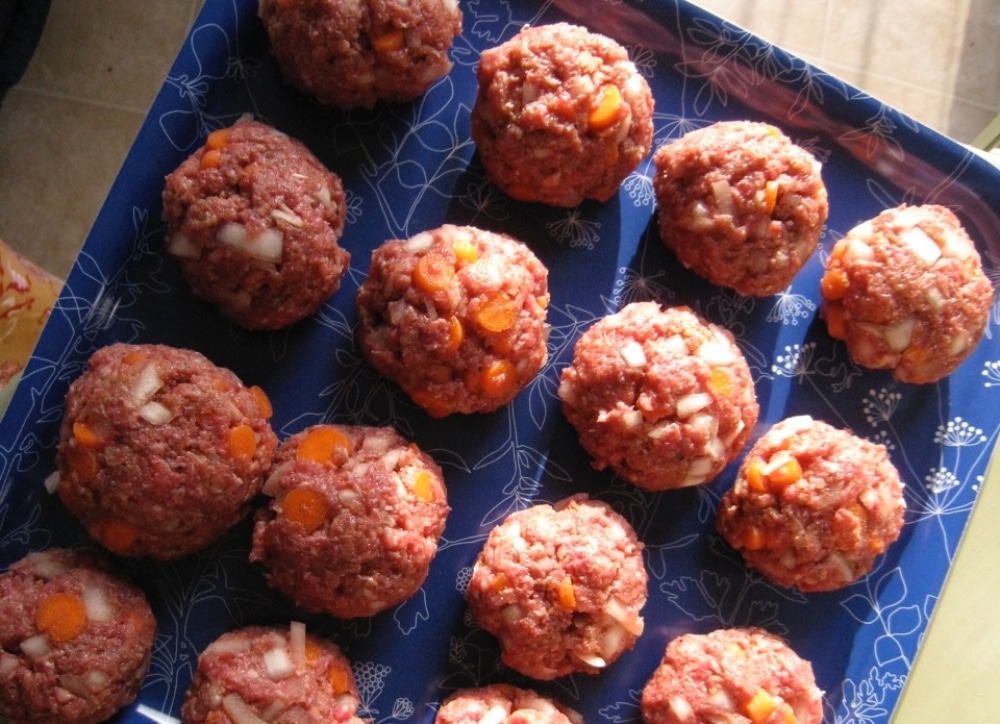
Hamburg steak patties before being cooked – Photo Credit: tannaz
After combining all the ingredients, you shape the ground meat into a centimeter-thick oval patty, throw it onto a skillet, cook until browned on both sides, and there you have it, a certified Japanese hambāgu. Whether it be a last-minute addition to your bento lunch, something you happen to order at a mom-and-pop shop on your way back from work, or a home-cooked meal, the hambāgu, though simple, is always a luxury.
A trip down hambāgu lane
As you chow down, you are tasting thousands of years of cultural diffusion, as what appears to be an unassuming meat patty sits at the bottom of a vast culinary family tree. Though the ‘true’ origins of the hambāgu are debated and difficult to verify, there is one theory that holds steadfast.
The Tatar people of Central Asia were prolific equestrians, who not only used their steeds as a method of locomotion but also as food. On account of horse meat being quite coarse, to render it edible, they would tenderize it into soft, tenable portions, a precursor to the steak tartare. When the Tatars invaded Europe in the 13th century, countries such as France, Belgium, and Germany got a chance to try this peculiar cuisine.
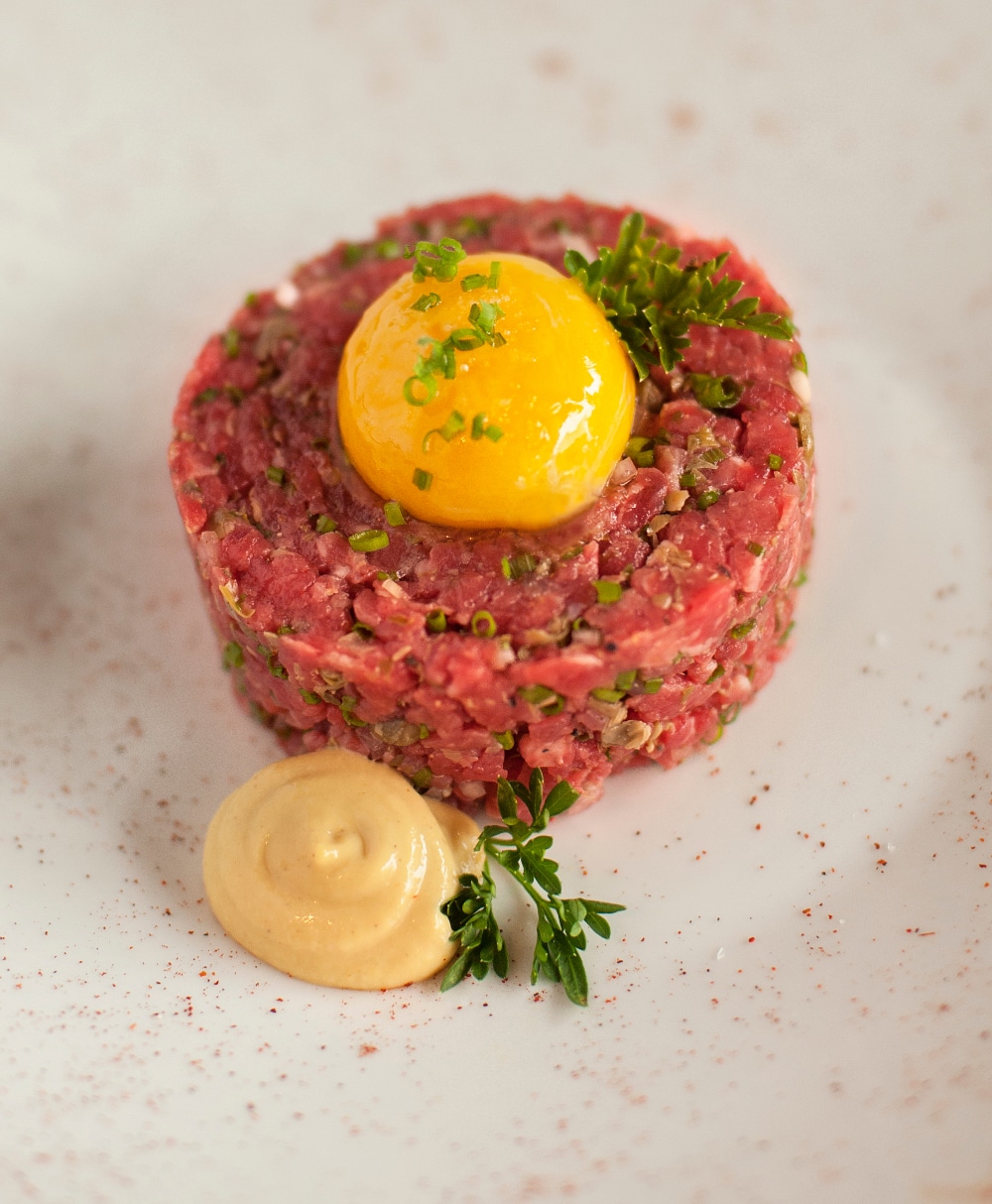
A modern-day example of the steak tartare – Photo Credit: Kurman Communications LLC
By the 18th century, it had become popular in German home cooking to grill steak tartare from affordable minced meat, toss in some breadcrumbs, and mold it into a patty. This would become known as frikadelle or bulette, a type of meatball, and was greatly enjoyed among sailors and workers in the ports of Hamburg. When these sailors immigrated en masse, between the 18th and 20th centuries, they brought their frikadelle, or as many would come to call it, the Hamburg steak. When this new food touched down on U.S. soil, the Americans adapted it into the good ol’ fashioned hamburger.
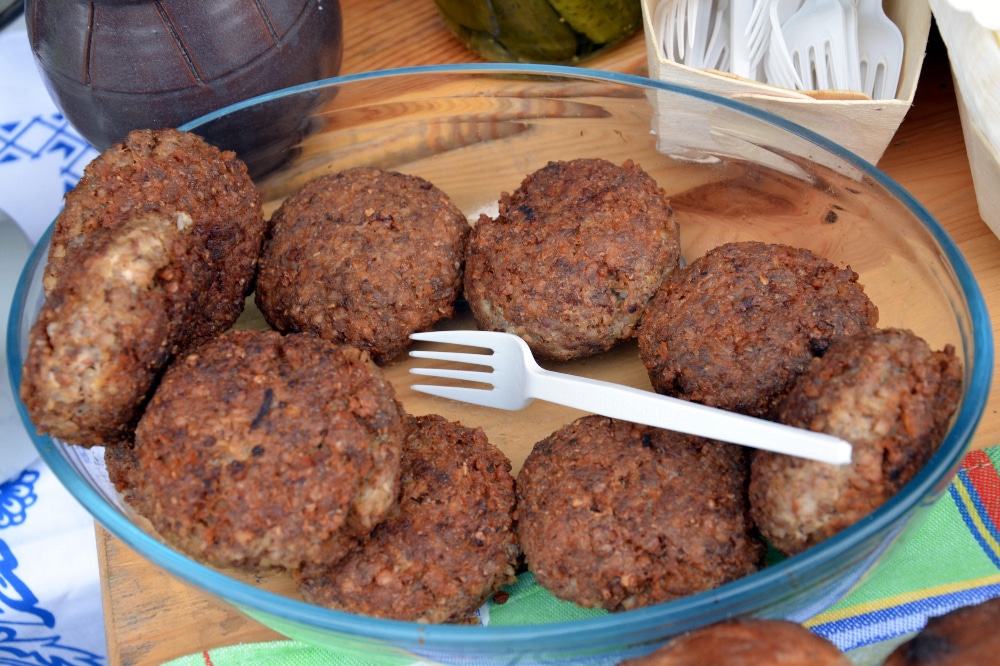
A bowl-full of frikadelle – Photo Credit: Silar
The Meiji period (1868 – 1912) saw the fall of the mighty Tokugawa shogunate, the ascension of the Emperor, and the ratification of a new constitution, but more importantly, it would also mark Japan’s encounter with the Hamburg steak. Before this, the Japanese population adhered to a strict Buddhist diet, which forbade the consumption of fish or meat. However, following the Meiji Restoration and the opening of Japan’s ports, rapid Westernization took hold, allowing for the gradual integration of a more Western food palette. And thus, a smorgasbord of delectable goodness entered from Europe.
The Akahori Kappo Kyojo, the country’s first cooking school, had its grand opening in 1882, and it was there that our historic dish made its debut, being served for the very first time in Japan. Lots of important firsts there! Following this, Hamburg steak, alongside similar ground-meat-based dishes, began to populate the menus of yōshoku eateries. Yet despite its induction into the yōshoku canon, meatloaf reigned supreme in popularity during this period. Interestingly enough, the term Hamburg steak hadn’t become widespread, most commonly being referred to as “German steak” or “mince ball”. Later, there would be a smattering of cookbooks that would include hambāgu recipes, such as Shintaro Takano’s The Complete Book on Western Cooking Methods (欧米料理法全書), published in 1905, which labeled it as “Hamborg steak” (ハムボーグ、ステーキ).
While the dishes’ profile would gradually rise through the late 1800s and early 1900s, in the aftermath of World War II, it would explode. In some ways, we have housewives to thank for the modern-day hambāgu. See, after the war, the availability of meat became widespread after years of scarcity. Housewives had discovered that by using a combination of pork and beef in tandem with other ingredients they had on hand, hambāgu served as a substitute for the more expensive minced meat options. Not only was this a supremely cost-effective and economical use of resources, but it was also pretty darn scrumptious! Couldn’t afford premium rib-eye? No worries! Just turn on the stove and whip up a steaming hambāgu!
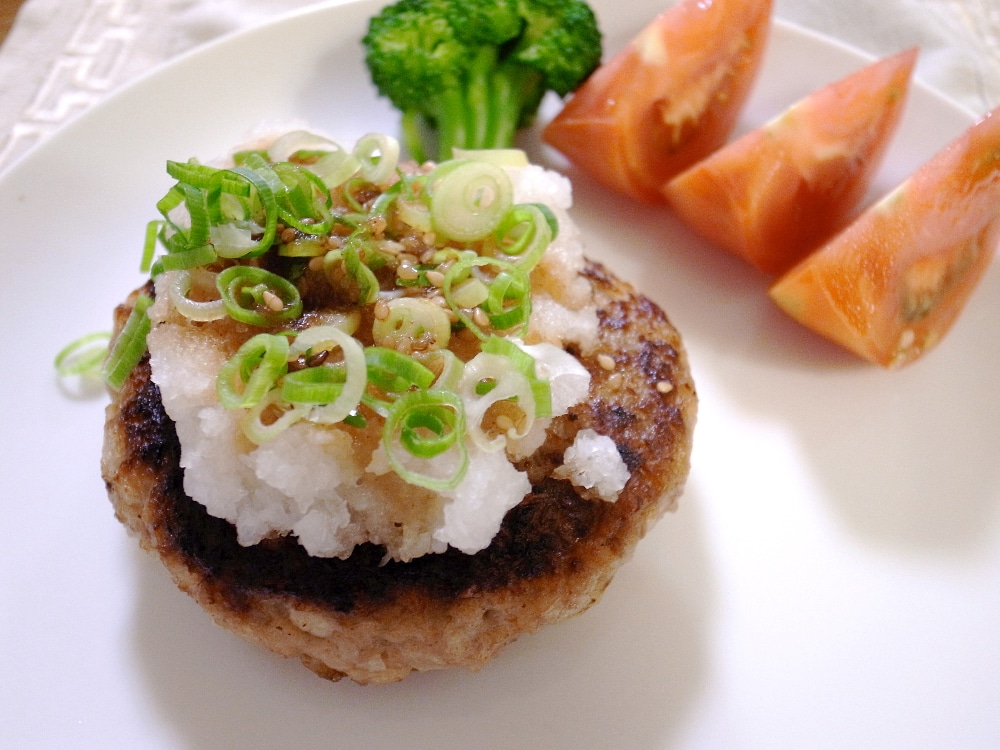
Wafu hambāgu – Photo Credit: Pelican
Hambāgu today
As the hambāgu began to be cemented as a classic, it was subsequently innovated upon, resulting in a medley of variations. There’s the wafu hambāgu (topped with grated daikon radish), the teriyaki hambāgu, the nikomi hambāgu, the tofu hambāgu – the list goes on and on!
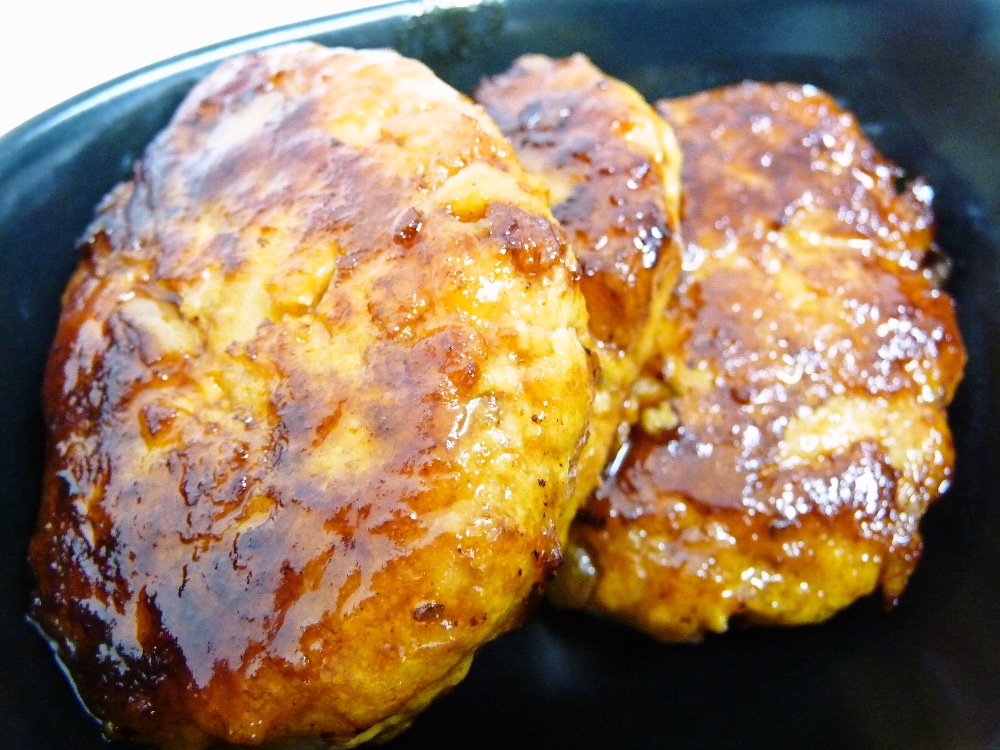
Tofu hambāgu – Photo Credit: Kakei. R
Hamburg steaks are usually topped with a sunny-side-up egg, green onion, sautéed mushrooms, Japanese curry, or even melted cheese. But if your heart desires it, we’re sure it can be done. As sauces go, demi-glace (jars of which can be found in Japanese supermarkets), ponzu, and tomato-based sauces are some of the most common.
If you’re interested in hopping in the kitchen and trying your hand at cooking it, aspiring hambāgu chefs can find pre-packaged minced meat in Japanese grocery stores called aibiki-niku (合いびき肉). This unique type of mince typically has a pork and beef ratio of 7 to 3, which grants the hambāgu a softer texture and richer umami-like flavor profile as opposed to if only beef were used. If this puts you into a yōshoku frenzy, know that aibiki-niku works well with other fusion dishes too! But if you’ve never been the best cook, you can also find vacuum-packed hambāgu with the sauce included.
Where to eat
Okay, so you’re visiting Japan, and you’re feening to trying out some Hamburg steak, but you’re not too sure where to go? No problem, we’re going to serve you some yummy restaurant recommendations!
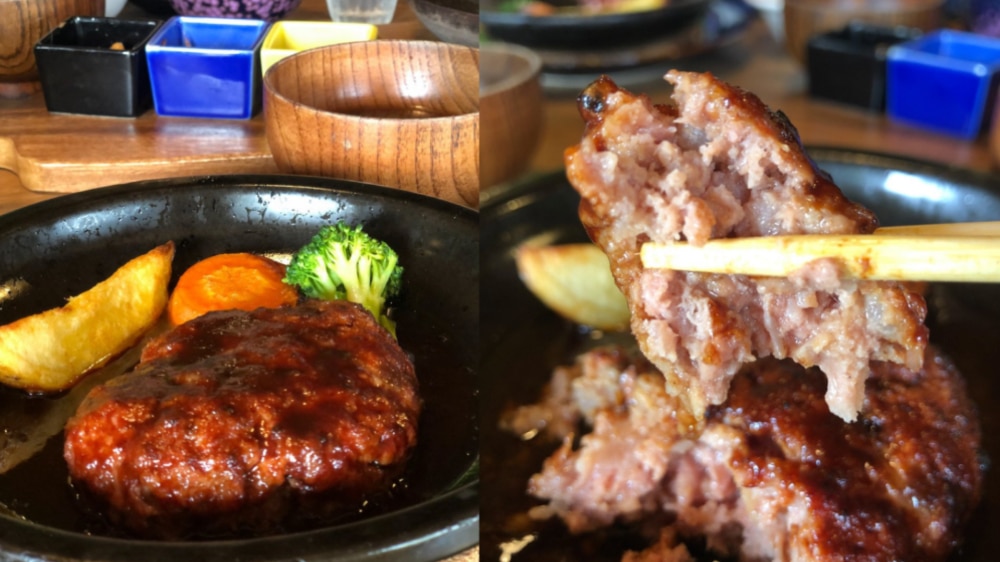
An example of Mutsumian’s hamburg steak – Photo Credit: @WireJess
First up is Mutsumian! Here at Arigato Travel, we’re no strangers to this homey family-owned restaurant. In 2022, we had the chance to interview the head chef and owner, Mutsumi Tanaka, and learn the secret behind the magic. Located in Shigaraki, Mutsumian’s bread-and-butter is its homegrown Koshihikari rice. Customers are asked to cook the rice in a locally crafted clay pot, which they, after a twenty-minute wait, get to serve with their choice of bowl and chopstick rest. Mutsumian is quintessential home cooking, and so it’s no question that, paired with the rice, its hambāgu is drop-dead delicious.
Location: 317-21 Shigarakicho Nagano, Koka, Shiga 529-1851
Hours: Weekdays (11:00 – 15:30), Saturdays, Sundays, & holidays (10:30 – 16:00)
Contact: 0748-82-3460 (Reservations are required and can only be made by phone)
Many come far and wide to enjoy, so if you happen to find yourself near or around the Lake Biwa area, we implore you not to miss out!
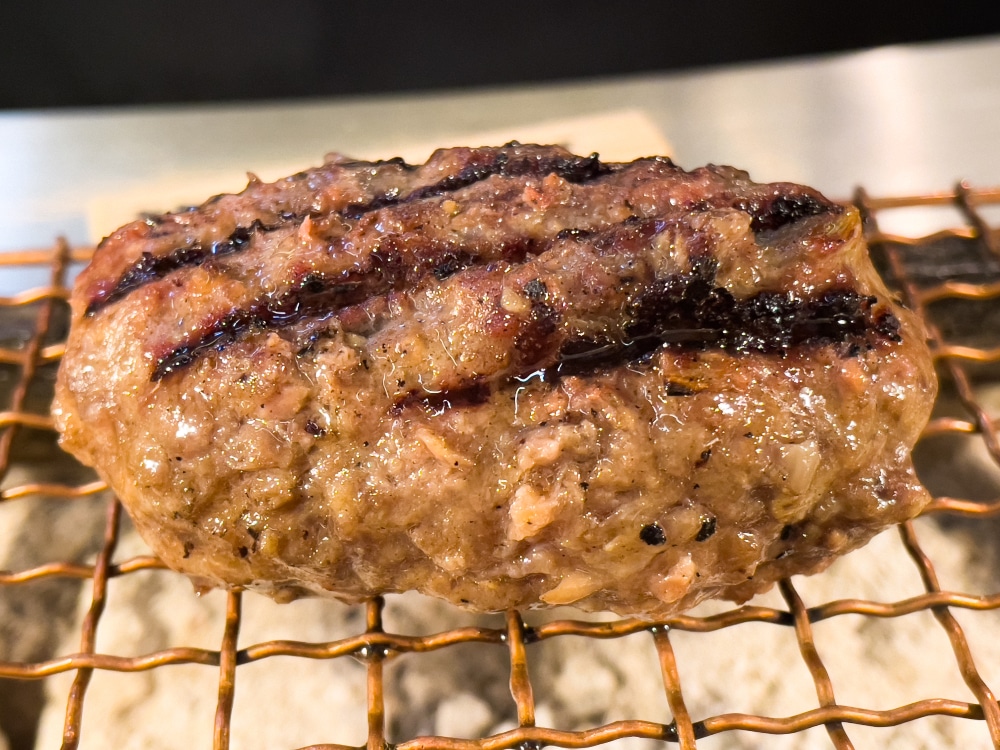
A fresh off-the-grill Hamburg steak at the Hikiniku To Come Kichijoji location – Photo Credit: Dick Thomas Johnson
Next on our list is Hikiniku To Come. With locations in Kichijoji, Fukuoka, Kyoto, and Shibuya, Hikiniku To Come can be considered a prestigious hambāgu location. Charcoal grilled in front of customers, and served atop a steaming bowl of rice, “freshly ground, freshly baked, freshly cooked” is their motto. They are dedicated to bringing customers “the best tasting moment.”
Location: 〒150-0043 Tokyo, Shibuya City, Dogenzaka, 2 Chome−28−1 椎津ビル 3F
Hours: Daily (11:00 – 21:00), Closed on the 1st and 3rd Wednesdays of the month
Contact: 03-6455-2959 (Reservations can only be made online; seats can be reserved here)
While a reservation is required to dine (and must be booked seven days before the intended visit date), that can be easily done online, and in our opinion, is totally worth it!
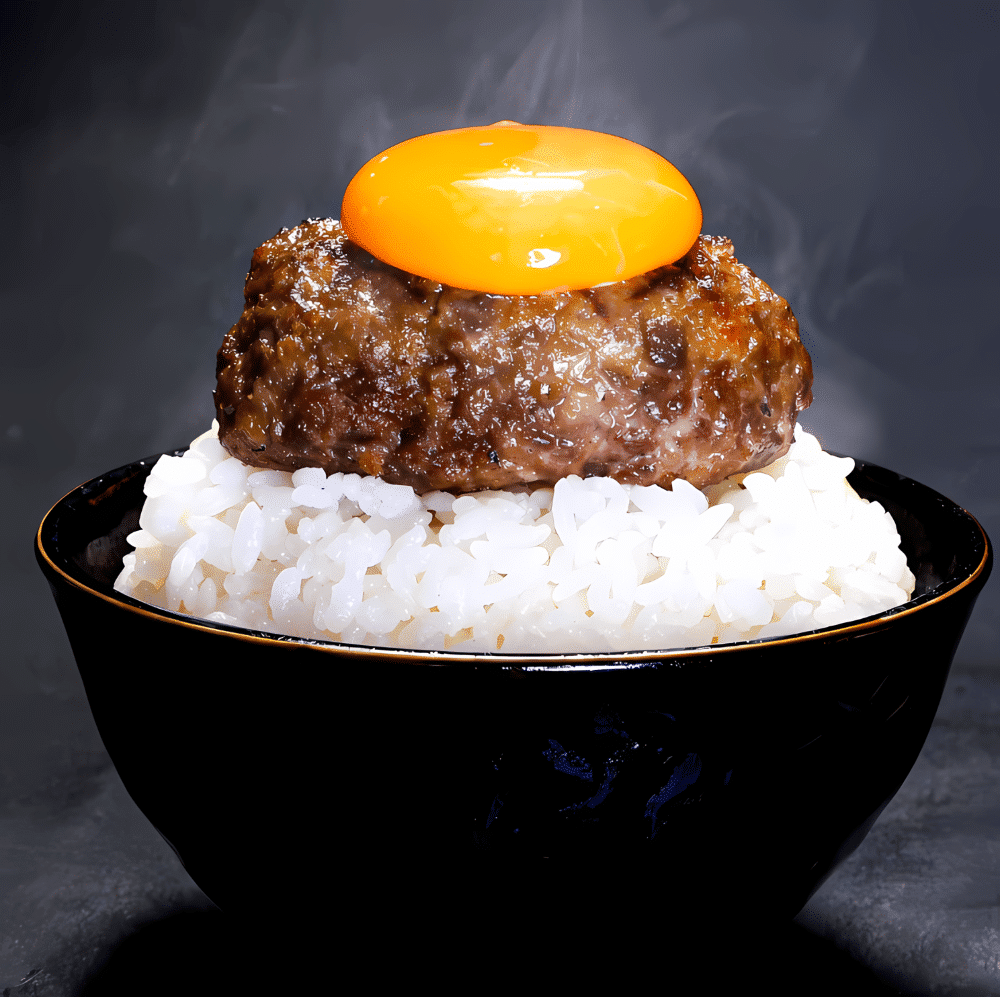
A Matsuya-seinikuten Hamburg steak with an egg on top – Photo Credit: Matsuya-seinikuten
Over in Chiyoda, we’ve got Matsuya-seinikuten, which was founded all the way back in the Meiji Period and continues to bring the traditional taste of the Hamburg steak to this day. 100% beef, 100% incredible.
Location: 5 Chome-4-2 Sotokanda, Chiyoda City, Tokyo 101-0021
Hours: Daily (11:30 – 14:30, 17:30 – 22:00)
Contact: 03-5846-8806
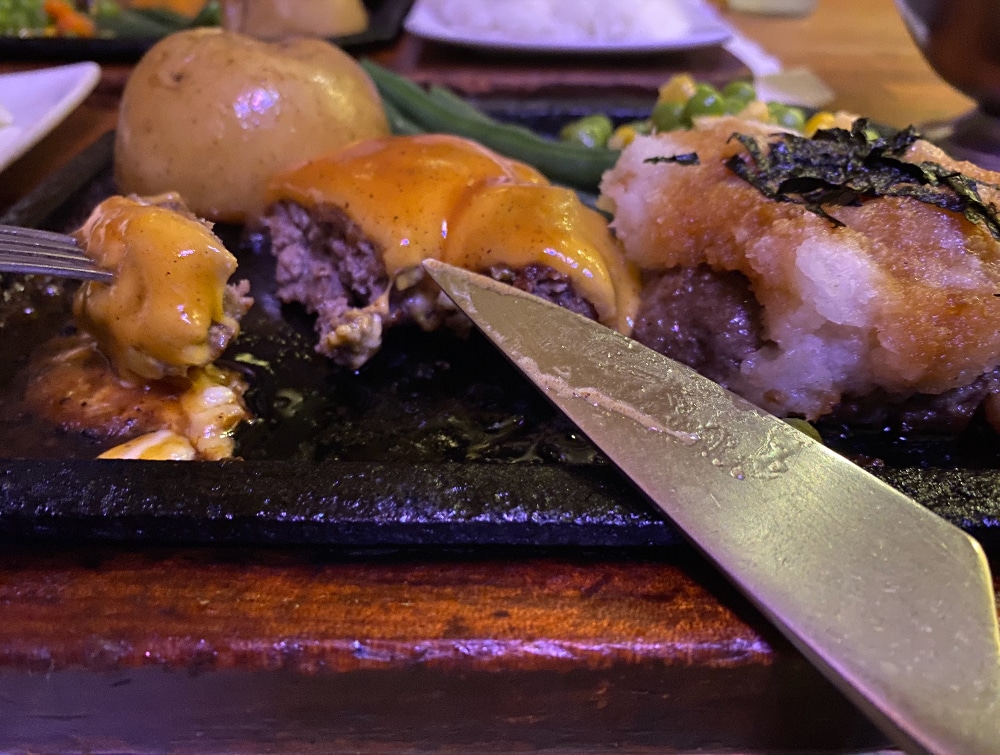
A cheese and wafu hambāgu at the Gold Rush in Shinjuku – Photo Credit: @malaika_w_kamau
To close out our recommendations, I would be remiss not to mention Gold Rush. Nestled in the side of a building, down a narrow flight of stairs, is a warmly lit Hamburg specialty bistro. Strewn with allusions to Americana, the cozy down-to-earth atmosphere swirls with an appetizing aroma. As your meal is served, doused in gravy and Demi-glace, there is an orchestra of sizzling oil, popping off like firecrackers. When it settles, it gives way to some of the best Hamburg steaks in Tokyo! Grilled to absolute perfection, it is succulent and bursting with flavor. Complemented by a side of glistening potato, rice, and balanced out with veggies, it’s super hearty! The glorious cheese pull almost made me cry, and the radish made a refreshing topping. Let’s just say I’m going to be back here a few times (and by a few times I mean like a lot of times…).
Location: Gorudorasshu Shinjukuhigashiguchiten, 新宿ターミナルビル B1F 3 Chome-23-1 Shinjuku, Tokyo 160-0022
Hours: Daily (11:30 – 15:00, 17:30 – 22:00)
Contact: 03-3355-0533
Some of our most influential memories revolve around food, from boisterous conversation over the dinner table to contemplative moments alone; we never eat in isolation. All foods come with a side of remembering, and the Hamburg steak truly encapsulates this sentiment. Mouthwatering, delectable, the peak comfort food, what else is there to say? There is honestly no end to the immaculate sense of fullness one can receive when gorging on this incredible meal. Go out there and dig in!
Featured Photo Credit: Chihaya Sta