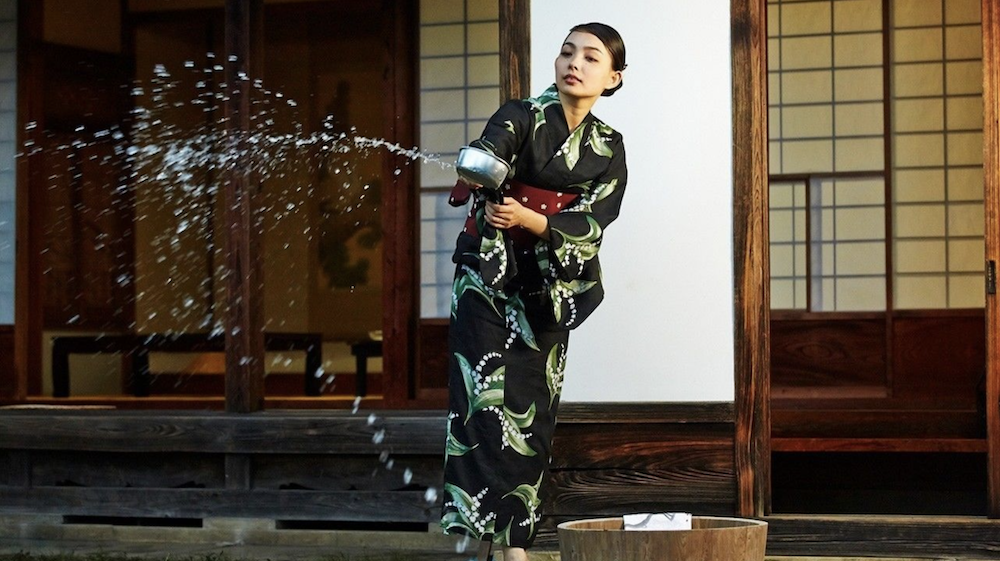
I was once in Yanaka, and I saw a lady fling a ladle of water from a bucket onto the sidewalk outside her shop early in the morning. She did it a few times, and the concrete darkened in uneven patches. Although the point of this exercise was to cool the air, I passed by too quickly to notice any change in temperature. She went back inside. I thought for a second about what I’d just seen, because it was one of those things where you realize you’ve probably walked past it a hundred times without registering what it was.
That was uchimizu. Uchi (打ち) means to strike or hit. Mizu (水) is water. It’s the practice of sprinkling water on the ground outside your home or business, and people in Japan have been doing it since at least the 1600s. It cools the pavement, settles dust, and makes the immediate area a bit more bearable in summer. It is also, depending on how far back you want to trace it, a gesture of spiritual purification and an act of hospitality.
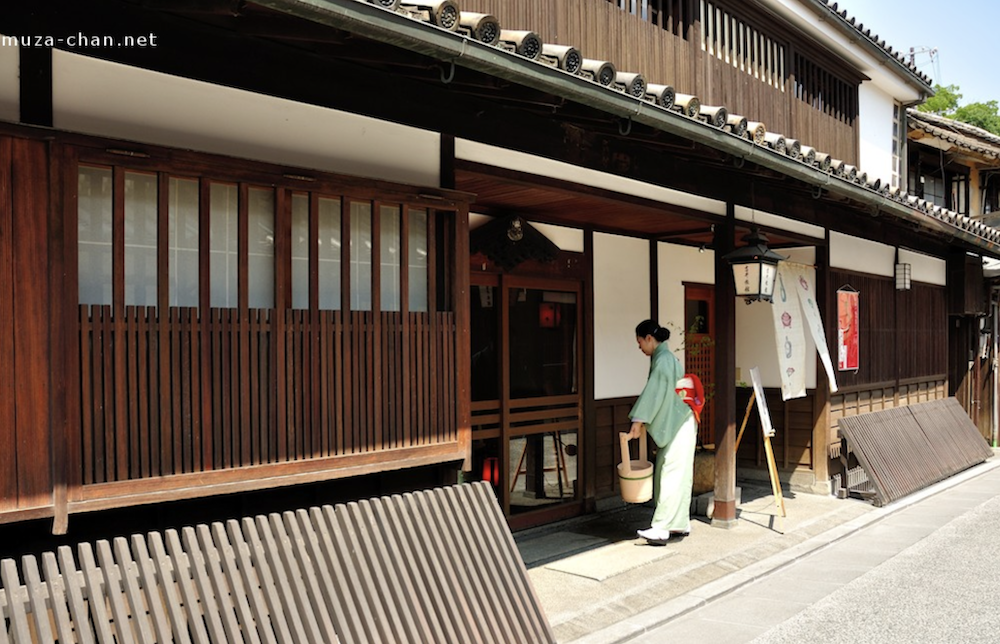
Uchimizu in Okayama – Photo Credit: Muza-chan
Before it was about heat
Long before uchimizu became a summer cooling trick, water already meant something specific in Japanese life. Shinto treats it as purifying. At any shrine, there is a stone basin near the entrance, the chozuya, where you rinse your hands and mouth with a bamboo ladle before approaching the kami. That simplified ritual comes from misogi, the much older practice of purifying your entire body in a river or under a waterfall. According to Japanese creation mythology, the god Izanagi washed himself in a river after returning from the land of the dead, and that act became the foundation for how water functions in Shinto. It removes spiritual pollution and makes things “clean.”
In the tea ceremony, a tea host would sprinkle water at the entrance to the tea room once everything was ready. Guests knew, by seeing the wet ground, that they were expected. It was a type of communication. In Kyoto, where the tea ceremony shaped daily manners more deeply than anywhere else, this spilled over into regular life. Sprinkling water at your gate became a way to welcome someone without saying a word. A few ryokan in Kyoto still do it, alongside burning incense from houses like Shoyeido that have been making incense for over three hundred years. It is a form of care that assumes you’ll notice, and doesn’t mind if you don’t.
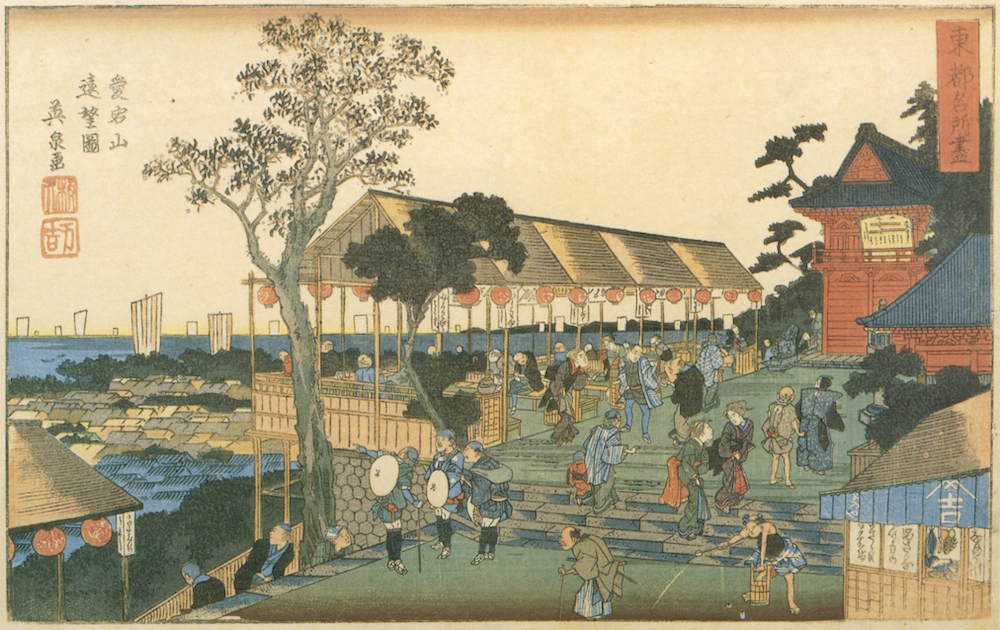
Edo period example of uchimizu at Atago – Photo Credit: Shokunin
Edo and the dust problem
The Edo period is when uchimizu became an everyday kind of practice that everyone participated in. Edo (now Tokyo) was massive, over a million people by the early 1700s, and for most residents, the roads were dirt. In summer, the dust was a big issue. It coated everything, and combined with the heat to make the city genuinely unpleasant. Sprinkling water kept it from rising up and cooled the surface. Water absorbs heat when it evaporates, so a wet road is measurably cooler than a dry one.
The routine was morning and evening. You swept the front of your shop or house, then sprinkled water. Neighbors did the same, and the whole street would be damp without anyone having organized anything. It was one of those bottom-up practices that no one mandated, but everyone participated in because the alternative was worse.
Kobayashi Issa, one of the great haiku poets, lived in Edo for years as a broke transplant from rural Nagano. He wrote a verse about how even the water you throw at your gate costs money when you live in the capital. That’s classic Issa, finding the tax embedded in a seemingly free act. But it also tells you that uchimizu was mundane enough to gripe about, which means it was everywhere.
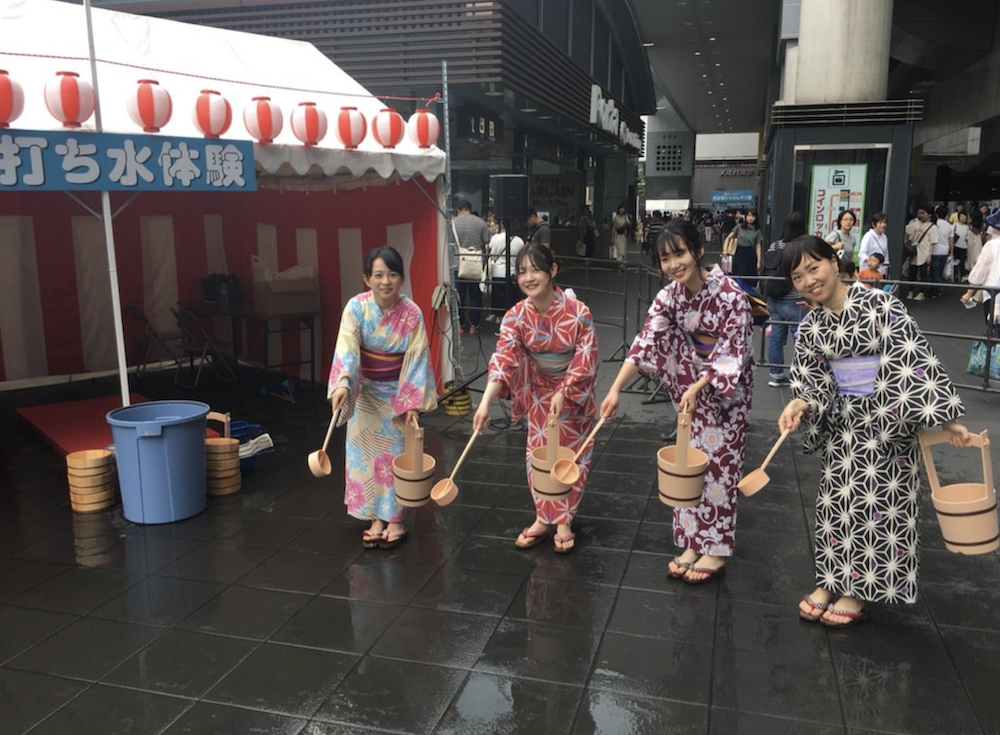
Kyoto mizumaki – Photo Credit: Amemblo
Kyoto kept it going
Kyoto is where the practice survived longest as a genuine daily habit. Until the mid-1970s, in the old residential neighborhoods packed with machiya, the morning started with kadohaki (sweeping the road in front of your house) followed by mizumaki (Kyoto’s word for uchimizu). The wife did it, or a grandparent, or a kid, or an employee. It varied by household. But every house or shop on the street did it, and by the time the day began, the whole road was clean and damp.
I think what made it last in Kyoto was that it fit everything else. The machiya were built for the climate already, with deep, narrow buildings with interior gardens and layers of sliding doors you could open or remove depending on the season. Uchimizu was part of the same approach. You worked with the heat rather than against it. But as communities thinned and machiya got demolished, fewer people bothered. By the 2000s, it was mostly old shops and a handful of households keeping it up. Air conditioning exists now, so it’s understandable, but some culture got lost.
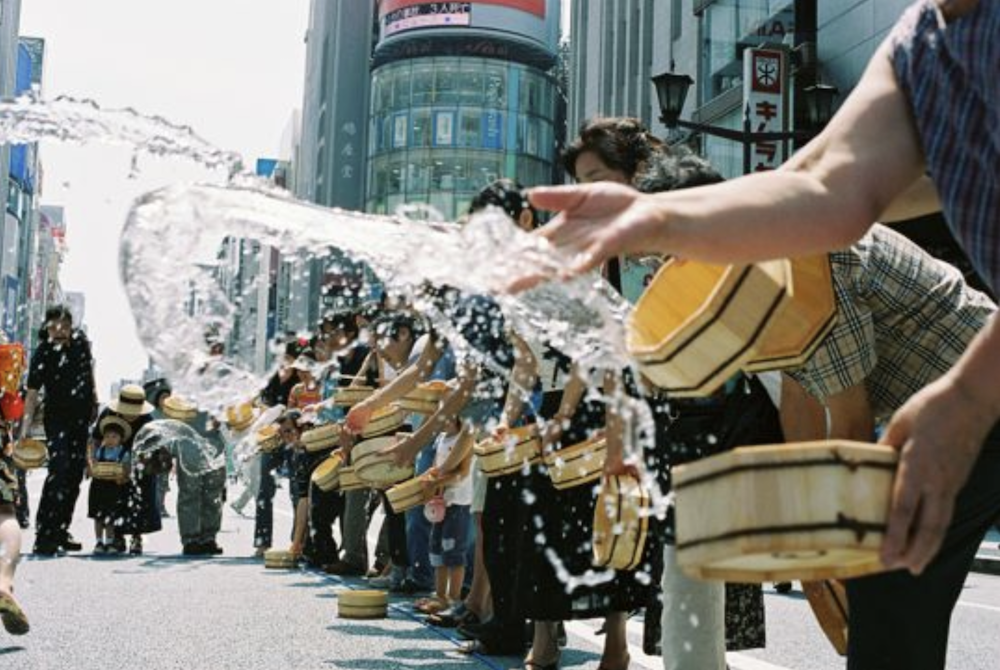
2003 Mission Uchimizu – Photo Credit: Greenz People
The 2003 experiment
In 2003, a coalition of environmental groups in Tokyo organized something called Mission Uchimizu. The idea was to get a huge number of people to sprinkle recycled water on the streets at the same time and see if it actually lowers the city’s temperature. Tokyo has a severe heat island problem. All the asphalt and concrete absorb solar radiation and radiate it back, making the city hotter than the surrounding countryside. Summers are notoriously brutal, so if collective uchimizu could knock even a degree off, that would be meaningful.
Around 340,000 people showed up for the first one, on August 25, 2003. They used bathwater, rainwater, and air conditioner drainage. Tokyo made reclaimed water available for free from treatment centers in Shinjuku, Koto, and Minato wards. Temperatures in the treated areas dropped about one degree Celsius. The next year, the campaign went national and ran for a full week. Over three million people participated. By 2005, it was 7.7 million. The annual campaign period became July 23 through August 23, and it has continued every year since.
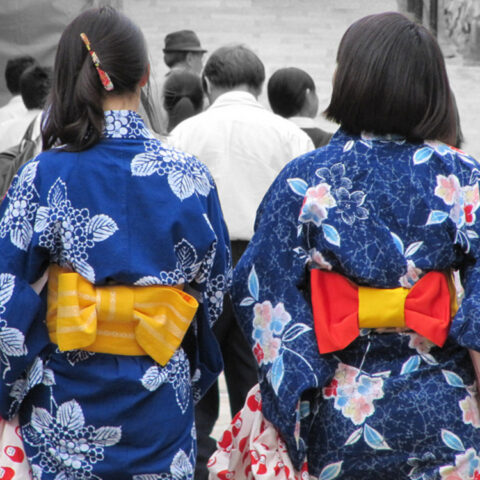
People wore yukata to the events, and gathered in shopping streets and plazas with buckets. There was something about the physicality of it that was meaningful. You can’t really feel good about adjusting a thermostat, but you can feel good about throwing water on hot pavement with your neighbors.
The science, briefly
A researcher at TU Delft named Anna Solcerova ran controlled experiments on uchimizu using fiber optic temperature sensors and confirmed what practice had already established: it always cools the ground. But timing matters. Morning and evening work best because the water evaporates slowly and has time to pull heat from the surface. Shade works better than direct sun for the same reason. Sprinkling water on scorching asphalt at 2 PM would just raise the humidity without getting much cooling in return.
So the Edo period timing, morning and evening, was not just tradition. It was correct. The accumulated experience of a few million people over a few hundred years produced the same result as a fiber optic cable array in a Dutch laboratory. A pretty satisfying discovery, I think.
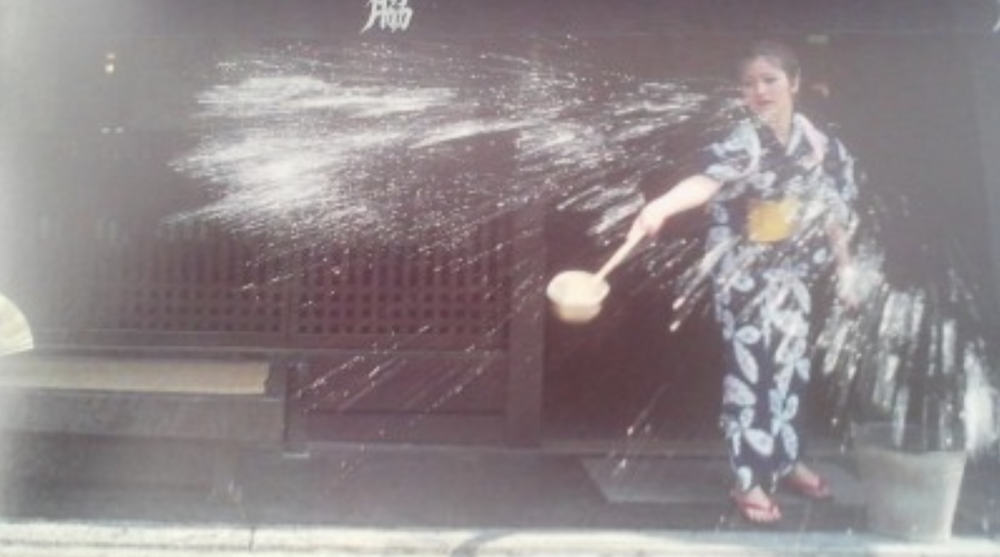
Old photograph of uchimizu – Photo Credit: Tsukublog
What it feels like
One thing that gets lost in the discussion of temperature differentials is what uchimizu actually feels like when you encounter it. The wet pavement outside a shop on a hot morning. The faint coolness. The visual difference between dry, glaring concrete and dark, damp stone. It registers before you think about it. Japanese environmental writers have pointed out that if pure efficiency were the goal, you’d use a hose or a sprinkler system. Uchimizu has survived because it changes the vibe of a place and is deeply cultural.
In the haiku tradition, uchimizu is a summer kigo, a seasonal word, grouped with wind chimes, shaved ice, and the evening breeze. Those are all things that exist partly to make summer livable and partly to acknowledge what the season is. They don’t fight the heat so much as they meet it halfway.
Still here
You can still catch uchimizu in some places if you’re looking. Some shopkeepers in older Tokyo neighborhoods do it before opening. A few places in Kyoto still treat it as hospitality. Mission Uchimizu events happen every summer across the country.
It has no official protection and is not a festival or a designated cultural property. It’s a habit that enough people found useful and meaningful that it kept going, from Shinto purification to Edo dust control to Kyoto morning routines to a modern environmental campaign. The woman I saw in Yanaka was not practicing a tradition in a performative way; she was doing something that made sense to her, on a hot morning, with a bucket of water. The tradition doesn’t really need anyone to preserve it. It just needs people who think a wet sidewalk is better than a dry one, which, during summer in Tokyo, is not a hard argument to make.
Featured Photo Credit: Nippon.com