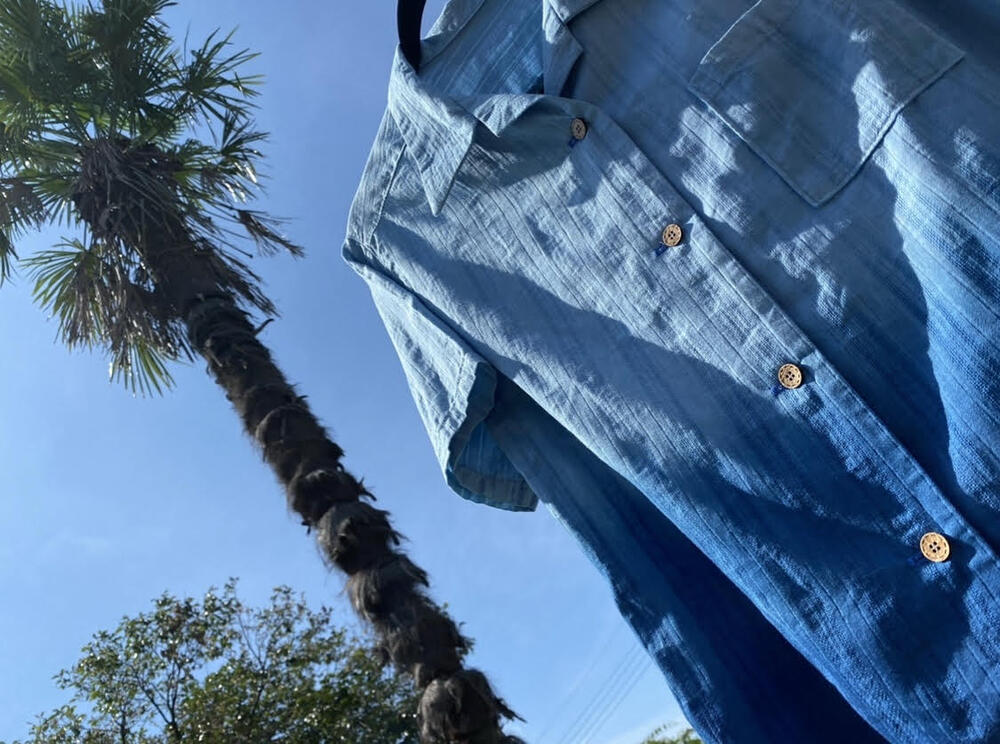
In the quiet countryside of Tochigi, Shoai Samurai invites guests to experience the true heart of Japanese indigo dyeing (Aizome) through hands-on creativity and community spirit. Here, every shade of blue has a story to tell, from the fields where the indigo plants are grown to the workshop where guests craft their own keepsakes using natural, chemical-free dye. Beyond the artistry, Shoai Samurai is a place where sustainability and inclusion thrive; where local children with learning differences learn, work, and share their talents. It’s an inspiring, authentic encounter with Japan’s natural beauty, craftsmanship, and compassion.
Curious to learn more about the people behind these beautiful blues? We sat down with Shoai Samurai to hear how their passion for indigo is changing lives and deepening connections to Japan’s handmade traditions.
Could you start by introducing yourself and telling us about your role at Shoai Samurai?
My name is Masayasu Wakabayashi, and I practice indigo dyeing at two locations: my home in Mibu Town, Tochigi Prefecture, and my studio in Tochigi City.
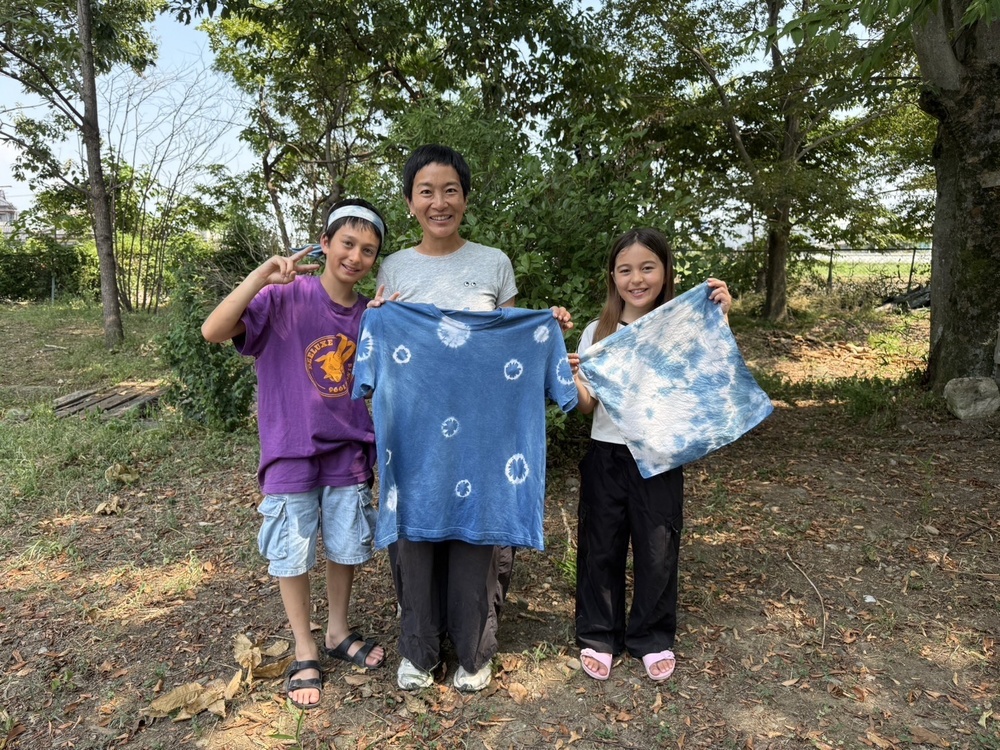
Guests with indigo dyed shirt and cloth: Photo Credit – Shoai Samurai
How did Shoai Samurai begin, and what inspired its focus on indigo dyeing and community support?
The corporation I work for operates various programs, including a correspondence high school and a Type B Continuous Employment Support facility. When a new Type B Continuous Employment Support facility opened in 2021, it prompted me to think, “Is there something I can do for the users?” and “Is there any way I can help, even a little?” That’s when I focused on indigo dyeing, something I’d long been interested in, and decided to launch it as a business.
The color indigo is said to have healing effects. It’s a traditional color cherished in Japan since ancient times and is now also called “Japan Blue.” Through this indigo blue, I hope it becomes an opportunity for our users to calm their minds and settle their feelings.
Furthermore, by introducing our users to the traditional craft of indigo dyeing at a young age, we hope to harness their concentration and creativity while also passing on Japanese traditions to the next generation. Driven by these aspirations, I resolved to launch the indigo dyeing business.
What kinds of indigo dyeing experiences can visitors enjoy here?
1. Indigo Dyeing Experience
Choose your favorite item from a handkerchief, bandana, tenugui towel, or stole, and create a one-of-a-kind design.
After designing your own pattern, carefully dye it until you achieve your desired shade.
Once you’ve reached your ideal color, rinse it thoroughly with water and sun-dry it.
After drying, it undergoes the final step of alkali removal (akunuki). Rinse it once more and sun-dry it again to complete the process.
Enjoy the deep, gentle indigo hues and the unique texture only handcrafting can provide.
2. Indigo Uchiwa Painting
Paint with indigo liquid using a brush on an eco-friendly uchiwa fan made from thinned cedar wood.
Drawing letters or pictures with crayons causes the indigo liquid to repel the crayon, making your design stand out.
The beautiful contrast between indigo and crayon creates a one-of-a-kind original uchiwa fan.
Perfect for creating summer memories or as a gift.
3. Strawberry Dyeing Experience
A sustainable (eco-friendly) dyeing experience utilizing strawberries destined for disposal.
Place a 100% silk handkerchief into a bag filled with strawberry dye liquid and gently knead it for the allotted time.
Once time is up, remove it from the bag and rinse with water.
After repeating this process twice, dry it in the shade to complete.
The result is a soft, gentle pink hue that conveys the warmth of nature.
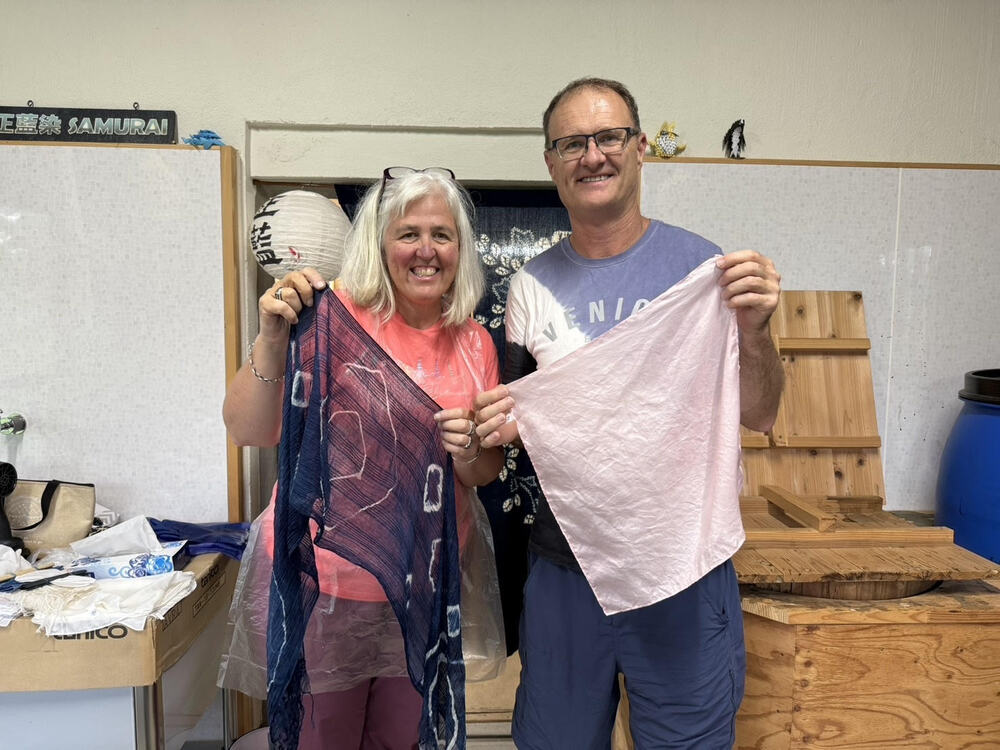
Guest with an indigo and a strawberry dyed cloth: Photo Credit – Shoai Samurai
Could you walk us through the most popular experience, what guests typically do, and learn?
For families visiting together, each person can choose their favorite fabric to dye. For example, with three people, you might choose “one handkerchief, one bandana, and one stole,” allowing everyone to enjoy creating their own unique piece.
Many participants also join our “strawberry dyeing experience” after completing the indigo dyeing. The chance to experience both tradition and nature in one visit is another reason for its popularity.
During the indigo dyeing process, there is a period where the dyed fabric is sun-dried. We use this waiting time to share fun stories about “what indigo dyeing is” and “its history” through our homemade picture-story shows and quizzes. Those who answer the quiz correctly receive a gift of my recommended sweets! This picture-story show and quiz are very popular with everyone from children to adults.
Rather than formal explanations, we focus on valuing communication with our guests, aiming to create a time to learn about indigo with smiles and enjoyment.
You grow your own indigo plants in Mibu Town. Could you share what goes into cultivating and fermenting the dye?
Integrated Approach from Indigo Cultivation to Dyeing and Sales
Indigo cultivation begins with raising seedlings in the spring. Once the shoots are sufficiently developed, they are transplanted to the fields, where we monitor their growth. In summer, we manage weeds and prevent pests, but we use absolutely no pesticides. Instead, we spray the indigo plants with traditional Chinese medicine and liquid indigo fertilizer. This cultivation method harnesses nature’s power, being gentle on both the environment and people.
When the indigo plants grow to about knee height, it’s time for harvest.
The harvested plants are separated by hand into stems and leaves, and the leaves are dried until completely brittle. These dried leaves are then fermented over approximately 120 days during winter to create “sukumo,” the raw material for indigo dyeing. While many dye houses mix stems and leaves to make sukumo, our company uses only 100% leaves. This dedication is the secret to producing a deeper, more beautiful indigo blue.
During fermentation, we carefully manage temperature and humidity by performing “water sprinkling” and “turning” once a week. Initial fermentation occurs around 16°C (61°F), but the temperature gradually rises, peaking near 70°C (158°F). Since temperatures above 70°C kill the microorganisms, we adjust the stack height and the amount of straw mats to maintain optimal conditions throughout fermentation. After approximately 100 days, the temperature stabilizes, and the sukumo nears completion.
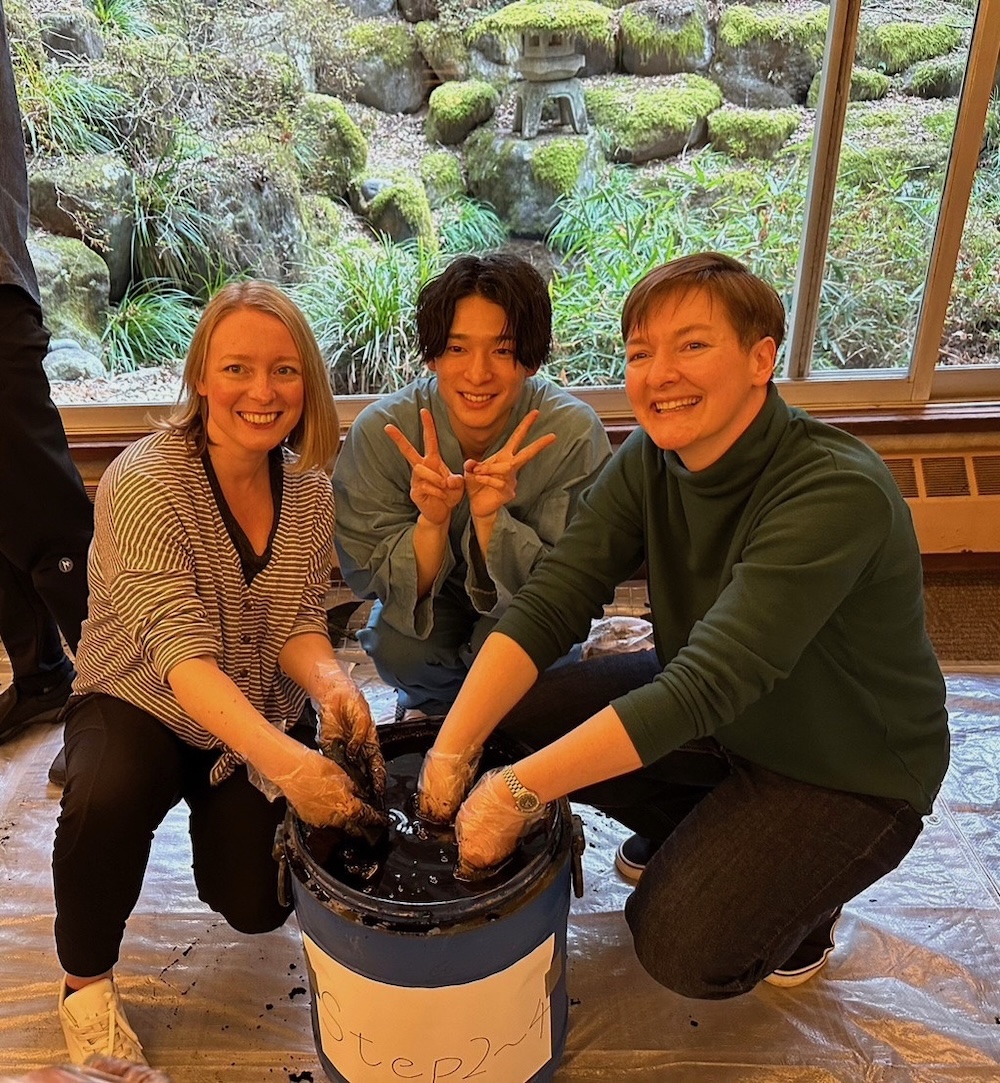
An artist and two guests posing for a photo with a bucket of indigo dye – Photo Credit: Shoai Samurai
Preparing Lye and Completing the Indigo Liquid
We don’t waste the dried stems either. The stems are burned into ash. Once cooled, they are sifted to remove impurities. The ash is then roasted over high heat for about an hour to evaporate moisture, creating fine, loose ash. Water is poured in and stirred. The clear liquid that rises to the top is lye (aku). Combining this lye with the sukumo creates the indigo dye solution used for dyeing.
While other dye shops may use broadleaf tree ash or chemical dyes, our company strictly adheres to traditional methods rooted in ancient techniques and natural materials.
However, simply mixing lye and sukumo does not complete the indigo solution. Over several weeks, we observe the dye solution daily, adjusting its temperature and fermentation state. Through careful “kasage” (a process of gradually adding ash water), we incrementally increase the amount of ash water until the beautiful indigo dye solution is finally complete.
Learning the “Joy of Work” and the “Spirit of Craftsmanship” Through Indigo
By handling everything from indigo cultivation to dyeing and sales, we realize “local production for local consumption,” creating a cycle of production and consumption within the community.
Seeing indigo we cultivated with our own hands become products that bring smiles to customers, we strive daily so our participants can feel this same joy. Through this activity, we grow together with our participants, accumulating diverse experiences: the challenges of work, the importance of earning money, and the joy and fulfillment of selling products.
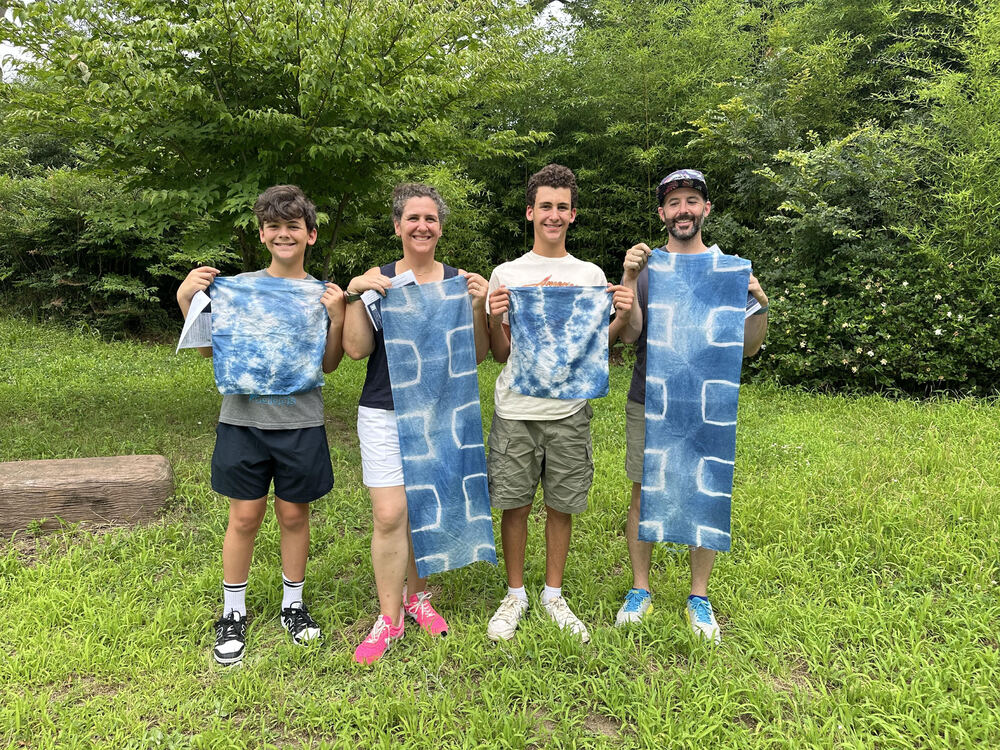
Guests smiling with indigo dyed crafts: Photo Credit – Shoai Samurai
Unlike many studios, you avoid chemical dyes. What difference does that make for the finished items and the environment?
Our Commitment to Natural Indigo and the Spirit of Carrying On Tradition
We don’t reject the use of chemical dyes outright. However, I feel that “indigo dyeing” is fundamentally a traditional Japanese craft passed down since ancient times, and using chemical dyes risks straying from its true essence. Of course, I understand the modern mindset that “you can’t make a profit unless you sell a lot.” Even so, I can’t help but wonder: Is it truly beneficial to pursue efficiency at the cost of altering the very foundation of tradition?
While chemical dyes allow for easy, inexpensive deep indigo dyeing, they fade easily with each wash and require drying in the shade, making them difficult to handle. In fact, I’ve heard stories of stores selling indigo-dyed items made with chemical dyes in department stores receiving numerous complaints like “The color bled onto other clothes,” eventually forcing them to stop selling these products. On the other hand, natural indigo dyeing rarely has such problems. Even when washed with white clothes, it doesn’t bleed color, and sun-drying actually makes the color more stable.
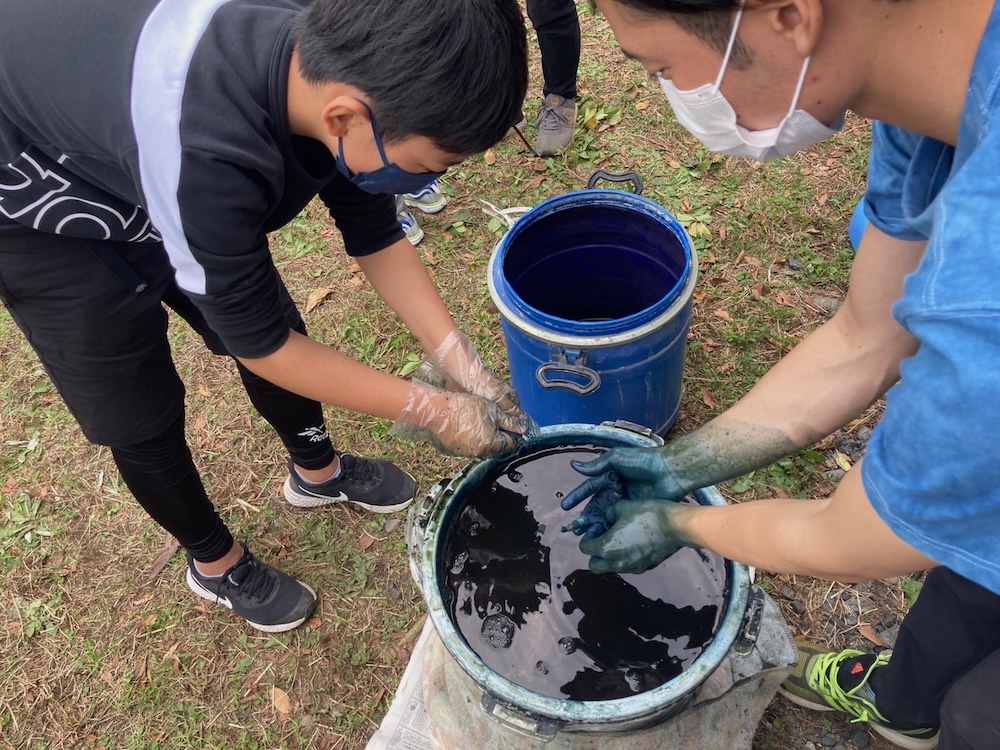
Washing dye covered hands – Photo Credit: Shoi Samurai
Furthermore, natural indigo has various benefits, including insect repellent effects, deodorizing effects, and UV protection. These benefits have been known since ancient times, and it is said that indigo-dyed cloth was highly valued in daily life during the Warring States period. For example, samurai wore indigo-dyed undergarments and hand towels beneath their armor.
Literature also records that during battle, when wounded, they utilized the antibacterial properties of indigo-dyed cloth for hemostasis. They also filtered muddy water through the cloth to make it drinkable, using it as a life-saving resource. Thus, indigo is not merely a dye; it is also a natural gift that has supported people’s lives and health. That is precisely why I carefully convey the charm and inherent goodness of natural indigo to customers when opening shops or offering experiences, ensuring the proper transmission of this fine old tradition and preventing the spread of misinformation or oversimplified perceptions.
Furthermore, a major characteristic of natural indigo is its ability to express a wide range of shades, from pale indigo to deep navy blue.
All materials used are natural ingredients safe for human consumption. Therefore, even when rinsed in rivers after dyeing, they have no impact on the environment. We cherish this “authentic indigo dyeing” that exists in harmony with nature and aim to pass it on to future generations.
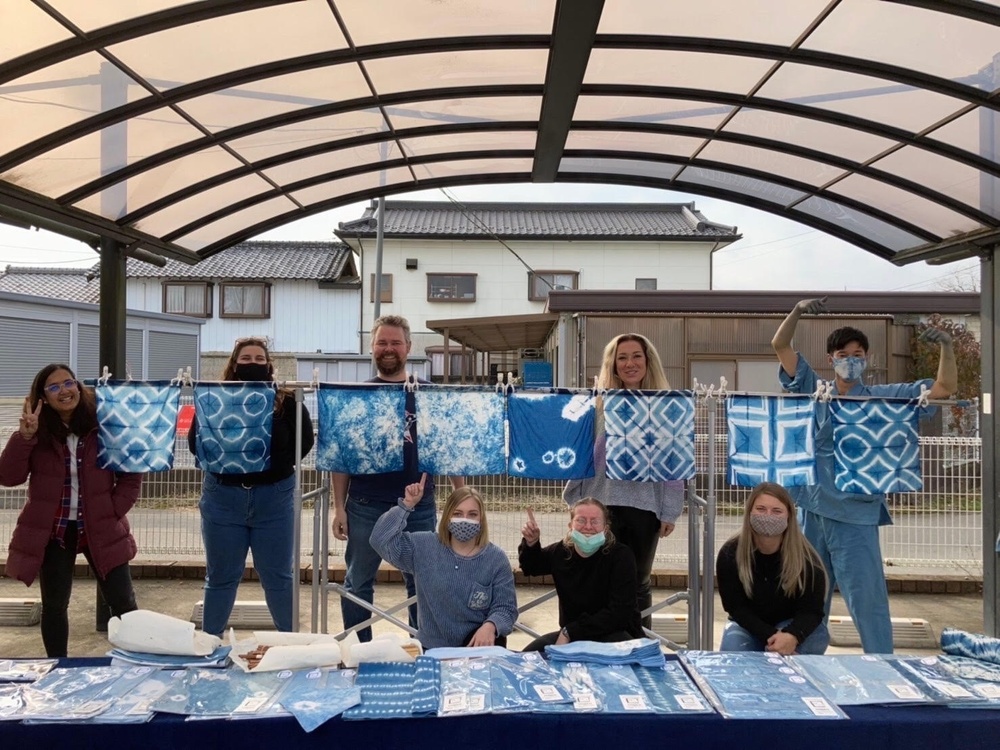
Large group dyeing session: Photo Credit – Shoai Samurai
I noticed you have a café, Merry & Pono. What kind of dishes or drinks can visitors try there, and do you grow your own ingredients for the dishes?
At our cafe, we serve Hawaiian dishes like hamburgers made with special buns kneaded with indigo seeds, loco moco, and acai bowls. While not all ingredients are homegrown, we use pesticide-free vegetables harvested seasonally whenever possible.
Shoai Samurai supports children with learning difficulties. How does indigo dyeing play a role in their education and daily life?
Working in the fields allows them to move their bodies in nature while soaking up sunlight, which helps relieve stress and calm the mind.
Furthermore, they sell products they’ve made themselves at our pop-up stalls. By communicating directly with customers and explaining the appeal and thoughtful details of their products in their own words, they gain practical experience with language use and handling money. This accumulation of experiences builds their confidence.
When their creations sell, a larger portion of the proceeds can be paid back to the participants. Seeing participants report with beaming smiles, “Someone bought it!”, when items actually sell, gives me immense satisfaction. Witnessing their daily efforts and growth up close brings me great joy.
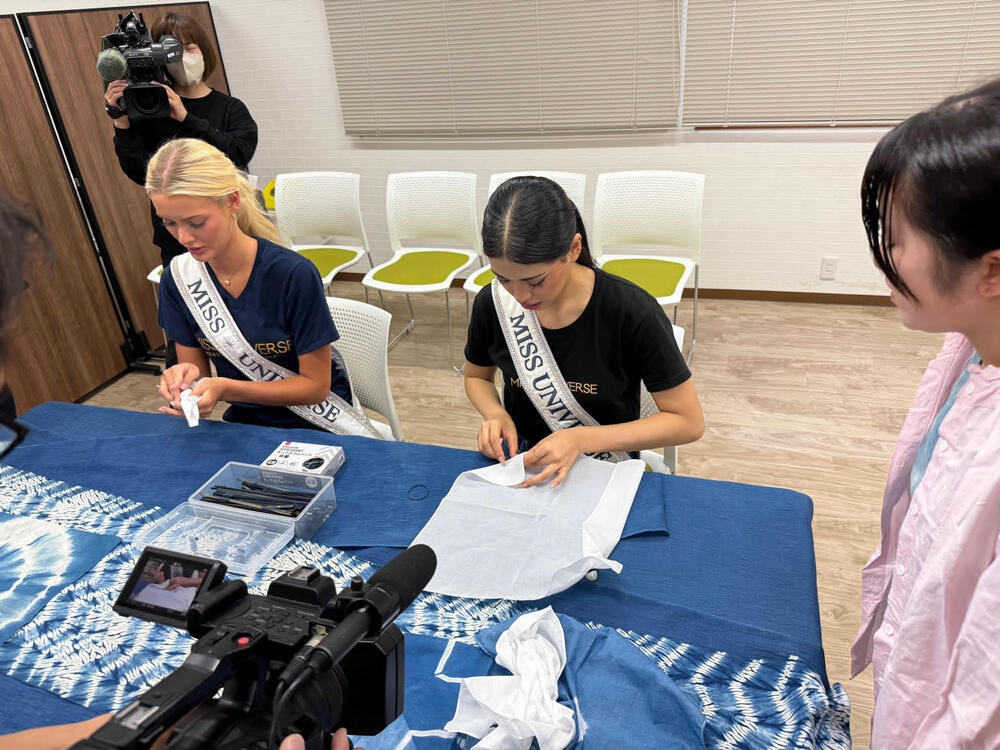
Miss Universe and Universe Japan winners participating in dyeing experience: Photo Credit – Shoai Samurai
Could you share a memorable story or moment with one of the students or visitors that captures the spirit of Shoai Samurai?
On April 22nd this year, we welcomed three brilliant and glamorous guests: Miss Universe winner Victoria, Universe Japan winner Kaya, and 2008 Universe Japan winner Hiroko. They participated in indigo dyeing and strawberry dyeing experiences at our facility.
On the day, two participants from our Type B Continuous Employment Support program served as instructors, carefully explaining the indigo and strawberry dyeing processes. The three guests listened intently to the explanations and actively engaged in conversation with our participants. It was their deep understanding of welfare and warm hearts that made sharing this precious time possible.
This experience became a significant source of confidence for our participants, a moment where a new light shone upon them. We remain committed to supporting our participants through such experiences, helping them break out of their shells and continue growing. We will walk alongside them, step by step, as they acquire the strength to move toward independence.
What do you hope guests take away from their visit, not just in the items they make, but in the experience itself?
It is precisely this: the “traditional craft” passed down since ancient times. And the realization that people who feel it’s difficult to live in the present can shine so brightly through welfare.
Here, we provide a place where everyone, regardless of disability, can shine as their authentic self. We value walking alongside each person to draw out their full potential and grow together. We would be delighted if our visitors could feel this spirit and experience, carrying it in their hearts as they leave.
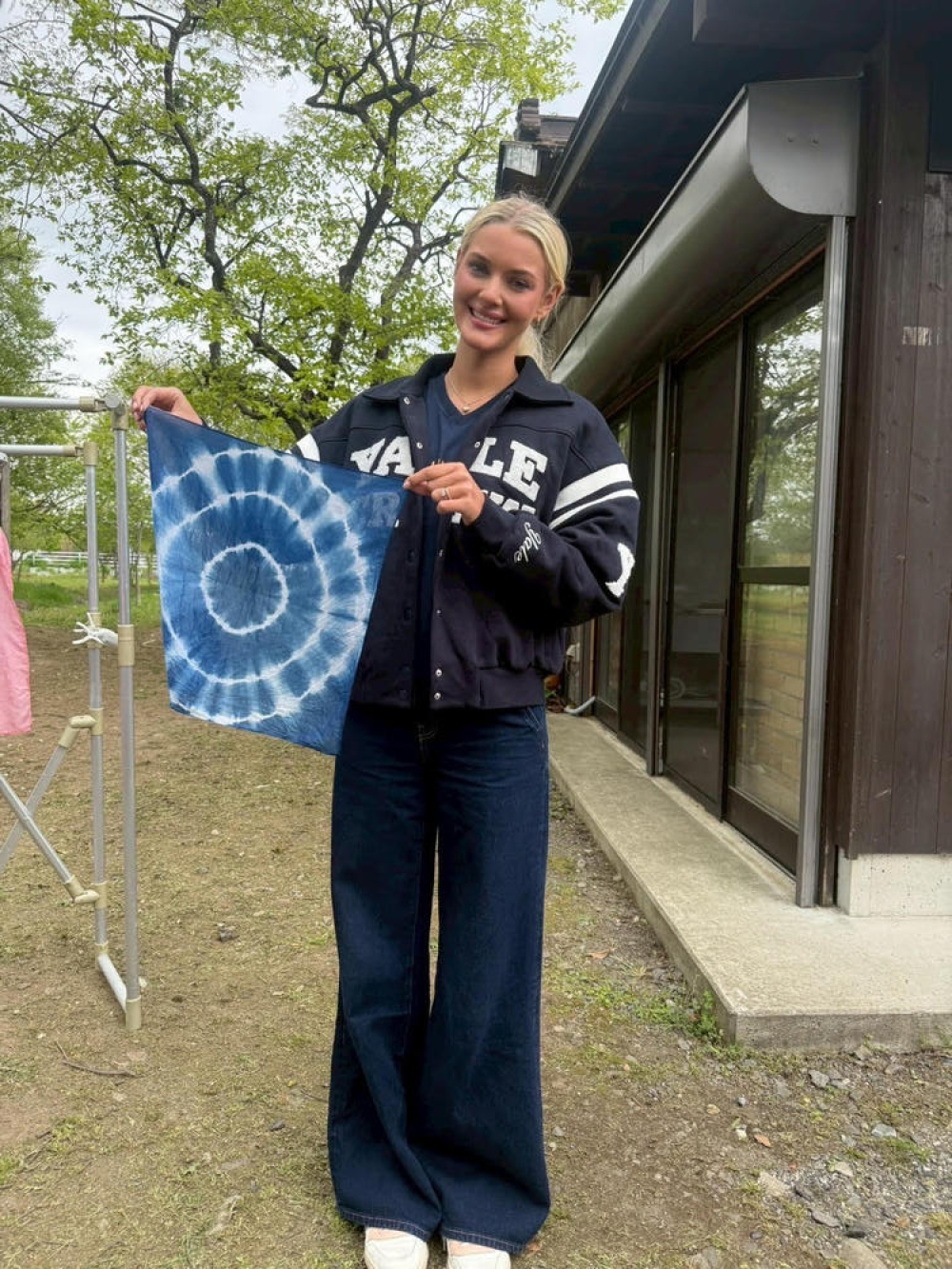
Miss Universe holding her dyed cloth: Photo Credit – Shoai Samurai
Lastly, are there any final thoughts you would like to share with our readers here at Arigato Travel?
We cherish and preserve the ancient natural indigo dyeing techniques passed down through generations, passing them on to the next. As a new initiative combining traditional crafts × welfare, we engage in community-focused craftsmanship through agriculture-welfare collaboration.
In modern times, many still feel sensitive or hold prejudices toward the term “disability.” However, we provide support to help each individual maximize their potential, regardless of disability, and we value creating an environment where everyone can thrive as themselves. The pieces created by our users, who face themselves sincerely and work diligently every day, are filled with talent, heart, and passion.
We would be delighted if you could see these pieces and feel something that touches your heart. And we would be happy if this experience could be a small step toward changing your perspective on “disability.”
Thank you to the team at Shoai Samurai for sharing your story with us and for welcoming visitors into your world of color, care, and creativity. Your work reminds us that travel isn’t only about seeing, it’s about connecting, creating, and supporting the communities that make Japan so special. For anyone looking to experience craftsmanship with heart, Shoai Samurai is a wonderful place to start.
Read more about Shoai Samurai on:
Website (English): https://nearbytokyo.com/fun/shoai-samurai-indigo-dyeing/
Website (Japanese): https://samurai.merryland.ed.jp/
Featured Photo Credit: Shoai Samurai